
AI for financial-services operations.Proof before you commit a build.
In a lending or financial-services operation, the drag is the reconciliation across systems that disagree, the periodic returns, and the re-keying between platforms that no off-the-shelf tool will touch.
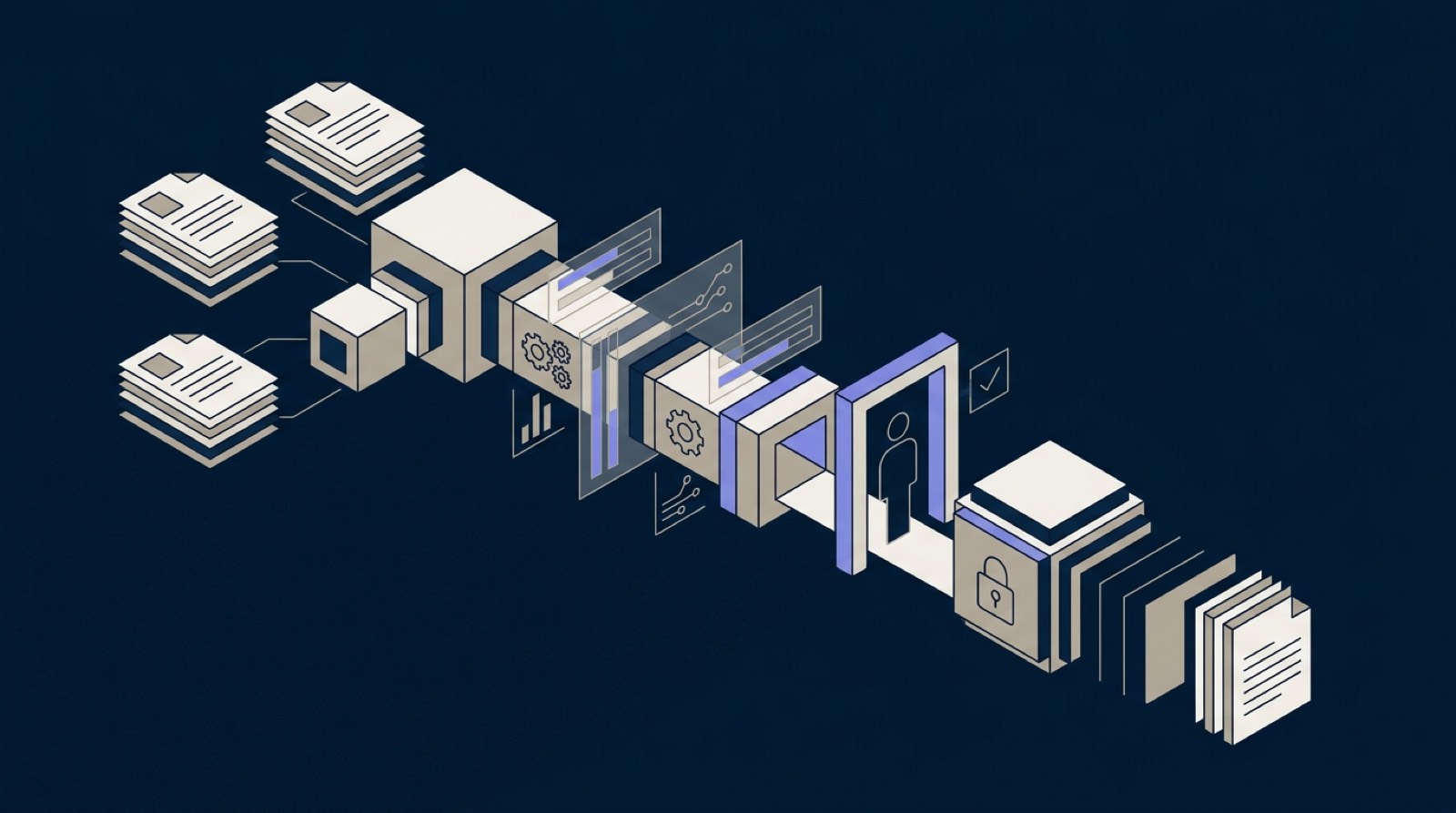
We reconcile the data first, then write approved results back into your core system through its API (the integration point a system exposes for other software), with a human in the loop at every step. We start with a fixed-fee operations review, prove the hard part on your real data, and only then build.
The data doesn't
agree with itself.
Systems that disagree with each other
The same customer, facility or account exists in three slightly different versions across your platforms. Every downstream report and decision inherits the contradiction, and someone reconciles it by hand.
Quoting that waits on manual re-keying
A quote sits in a queue while a person re-keys and checks it across systems. Speed is the sale, and the manual last mile is exactly where it's lost.
Periodic returns assembled by hand
Regulatory returns, management packs and reconciliations get compiled manually from data that lives in several places. It's a recurring scramble that pulls senior people off the work that matters.
Re-keying into the core system
Even once a result is approved, someone copies it into the system of record by hand. It's slow, and exactly where the errors you just removed creep back in.
Measured on real
finance operations.
less manual effort, PMD Finance
faster quote turnaround
from start to live
returned to one client (≈£120k/yr)
Reconcile first,
then write back.
The lines we
will not cross.
Writes are validated, idempotent and reversible, and every action carries a field-level confidence score and a full, exportable audit trail. These red lines do not move for a deadline, a client, or a confidence threshold.
We never automate a payment.
Not with approval, not with a confidence threshold, not just this once. A human makes payments by hand, every time.
We never automate a change to bank details.
The single highest-fraud-risk action in any operation. It stays manual, permanently, by design.
No submission reaches a regulator without explicit human sign-off.
Every regulatory return sits behind a hard pre-submission gate. The pipeline can assemble it; a named person releases it.
Audit first.
We say no in writing.
A fixed-fee operations review maps your whole operation, scores every workflow on six axes, and hands you a costed, sequenced plan, including the workflows we'd tell you to leave alone. No build is ever priced before we've proven the single hardest thing on your real data. If the proof fails, there's no build and you don't pay for one.
A fixed-fee operations review
Roughly two to three weeks. A handful of half-day sessions with the people who do the work, plus read access to a representative sample. You own every artefact, whether or not you go on to build.
Can you reconcile data across systems that disagree?
+
Yes, and we insist on it before any write-back. We build a harmonisation layer with entity matching, including fuzzy and probabilistic matching for the near-duplicates exact matching misses, producing one golden record per entity with full field-level lineage. Conflicts the rules can't resolve are surfaced to a human, never silently guessed.
Will approved results write back into our core system automatically?
+
A human approves first; then the result is written back through your system's API, sourced from the golden record. Writes are validated before they land, idempotent so nothing is written twice, and reversible via rollback paths. A complete audit trail maps every write back to the person who approved it, and we won't write back without clean, reconciled data.
How does this stay compliant and auditable?
+
Every extraction, edit, approval and rejection is logged in a full, exportable audit trail, and output carries field-level confidence scores. We never automate payments or bank-detail changes; those two highest-risk actions stay manual permanently. Nothing reaches a regulator without explicit human sign-off.
Do we have to replace our core platform?
+
No. We build around the systems you already use. Where a system has an API we write back through it; where a system is closed we use a supervised portal agent instead. You keep your core; we remove the manual reconciliation and re-keying around it.
See where AI pays
back in your operation.
UK STUDIO · REMOTE-FIRST ACROSS THE UK AND EUROPE
[email protected]