The North StackLadder.
AI doesn't fail in regulated operations because the models are weak. It fails because nobody sequenced the risk.
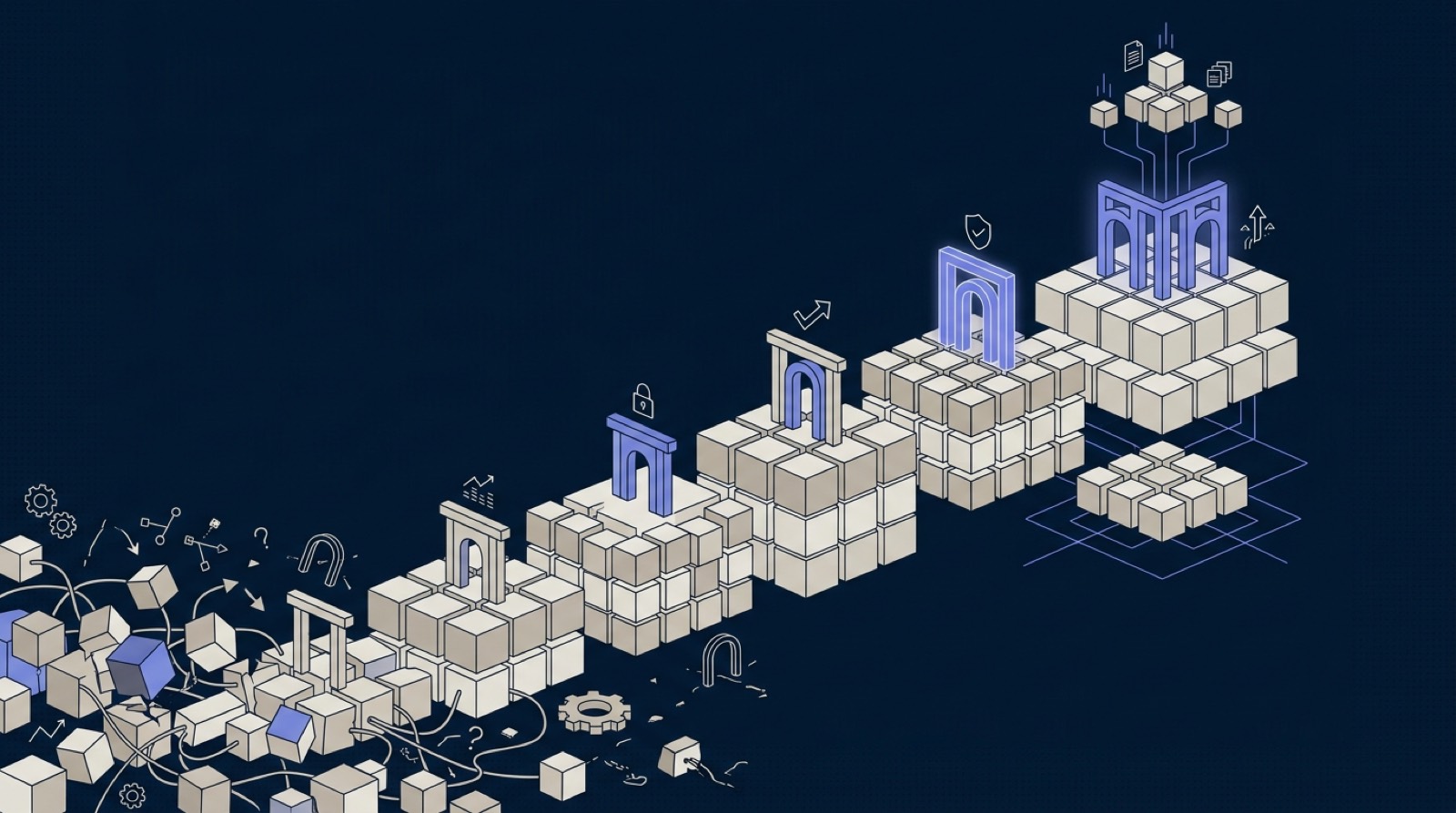
The North Stack Ladder is our five-rung method for adopting AI in complex, regulated operations. Each rung adds exactly one new thing the operation has to trust, and earns that trust before the next rung is built. We map your operation, score every workflow, prove the hard part before you commit to a build, and climb one rung at a time, with the governance tightening as the autonomy rises.
Build only what pays back. Never automate past the point a human can still be accountable.
less manual effort, PMD Finance
less document-review time, Marshall Peters
operational mins/day returned to one client (≈£120,000/yr)
human-approved, with a full audit trail
If we can't prove the hard part on your real documents, you don't pay for a build. We'll put that in writing.
Each rung adds one
thing to trust.
The top rung is supervised agents operating closed portals you'll never get an API for: the most-stuck, highest-value work in a regulated operation. We earn our way up to it; we don't lead with it.
Mapped
you can see the workBefore anything is built, the whole operation is visible and every workflow is scored.
What this rung involves
You have an honest, end-to-end picture of how work actually flows: the shared inboxes, the shadow spreadsheets, the portal swivel-chairs, the periodic compilations. Every workflow carries a number that says whether it's worth automating, in what order, and at what cost.
The conversation stops being 'we should do something with AI' and becomes 'we build these three, in this order, for this payback, and we deliberately leave these alone.' Decisions get made on evidence instead of the loudest opinion.
- An operations map of your core functions, with the four universal organs flagged: the shared inbox, the shadow spreadsheet, the portal swivel-chair, the periodic compilation.
- A scored workflow register. Every candidate is rated on the six axes, with a build / assist / decline call made explicitly.
- A costed, sequenced plan mapping each workflow to a rung of the Ladder.
- A written 'do not automate' list: the workflows where AI won't pay back, and why.
- Read-only access to a representative sample. Nothing in your systems is changed during the audit.
- The score thresholds are fixed and the same for every client, so the recommendation can't be talked up to suit a budget.
You're ready the moment you suspect parts of your operation are slow and manual but can't say which parts are worth automating or in what order. This is the entry rung, and almost everyone starts here.
Humans decide; nothing is touched
Assisted
AI reads, humans actAI retrieves, summarises and drafts. Your people still make every call.
What this rung involves
AI does the reading and the finding; humans keep the decision. A private system answers questions from your own documents with citations, or drafts a first version a person edits. It speeds the human up without ever acting on its own.
New staff get productive in weeks instead of months. Your experts stop being a human search engine for everyone else. The team learns to trust AI on low-stakes reading before anything depends on it.
- A private, access-controlled knowledge base built from your own documents.
- A retrieval interface that answers in plain English with citations back to the source passage, so the answer is checkable, not just plausible.
- Drafting and summarisation that a human reviews and owns.
- Runs inside your boundary; nothing trains a public model or leaves your environment.
- Role-based access control, so people only retrieve what they're cleared to see.
- Citations on every answer, so a claim can always be traced to its source.
You're ready when the answer is reliably somewhere in your documents but finding it is slow, and when the cost of a confidently-wrong answer is low enough that a human reviewing the output is sufficient.
AI reads, humans act
Automated
pipelines do the typing, humans approvePipelines read the inbound flood and compile the periodic returns. Humans approve before anything commits.
What this rung involves
A pipeline does the repetitive typing: reading inbound mail and documents and re-keying them, or assembling the quarterly declaration by hand. A person reviews the result against the original, with field-level confidence scores, and approves. The output is a clean import file or record, never an auto-sent action.
The single biggest source of operational drag disappears. The team stops typing and starts approving. The days-long quarterly scramble becomes a review-and-approve session.
- An ingestion and extraction pipeline tuned to your real document types and the fields that matter.
- A human-in-the-loop review workspace showing the original alongside extracted data, with field-level confidence scores and low-confidence flagging.
- Compilation engines that assemble periodic declarations, returns and board packs from live data on a schedule.
- A structured output (import file or record) ready for the downstream system.
- A human approves before anything is committed; output is never an auto-sent action.
- Every extraction, edit, approval and rejection is logged in a full audit trail.
- Anything bound for a regulator passes a hard pre-submission human gate.
- Each period's compilation is versioned and reproducible, so it's defensible after the fact.
You're ready when a high volume of repetitive work runs through a shared inbox or a periodic compilation, the rules are knowable, and a human reviewing flagged items is an acceptable control. This rung is behind most of our headline numbers.
Pipelines type, humans approve
Integrated
systems agree with each otherYour sources stop contradicting each other, and approved results write straight back into your core system.
What this rung involves
First we reconcile the data. The same customer, vehicle, policy or matter that exists in three slightly different versions becomes one golden record with full lineage. Then, once a human approves a result, it's written back into your core system through its API, so the last manual re-keying step disappears.
Every downstream automation, report and decision stops inheriting contradictory data. The final 'copy the approved answer into the core platform by hand' step is gone. That step was slow, and it was where the errors you just removed crept back in. The savings compound: the workflow goes from much faster to genuinely transformed.
- A harmonisation layer with entity matching, including fuzzy and probabilistic matching for the near-duplicates exact matching misses.
- A golden record per entity with full field-level lineage, and conflict-resolution rules you set and we encode.
- An API write-back from your approved review workspace into your system of record, sourced from the golden record.
- Conflicts the rules can't resolve are surfaced to a human, never silently guessed.
- Writes are validated before they land, idempotent so nothing is written twice, and reversible via rollback paths.
- A complete audit trail maps every write back to the person who approved it.
- We insist on reconciliation before any write-back. Writing bad data faster is not a win.
You're ready when a reviewed pipeline is proven and live, but a person is still re-keying the approved output into your core system. The prerequisite is clean, reconciled data, and we won't write back without it.
Humans approve every write-back
Orchestrated
agents work the portals, humans hold the gateSupervised agents operate the closed portals you can't integrate with, the ones locked behind multi-factor authentication (MFA), with a human approving every critical action.
What this rung involves
Some of your most painful work happens in systems you'll never get an API for: the insurer portal, the regulator submission system, the legacy core behind a login. Supervised Claude agents operate them the way a trained member of staff would, but every critical action pauses for explicit, per-action human approval before it happens.
A £50-a-month SaaS can never touch the swivel-chair work, because the system is closed by design. Supervised agents get it done at machine pace, while a human stays accountable for every consequential step. This is the highest-value, most-stuck terrain in a regulated operation, and almost no one else will go near it.
- Supervised agents that log in, navigate, read and enter data in your closed, MFA-gated or un-integratable portals.
- A supervision and exception workspace where your team approves, edits or halts the agent.
- A failure and incident playbook so any stuck or unexpected state escalates safely to a human.
- Per-action human approval on every critical step, enforced before execution. Nothing high-stakes is autonomous.
- Permanent red lines: no automated payments, no automated bank-detail changes, full stop.
- Regulator submissions sit behind a hard pre-submission gate.
- Role-based access control and a complete, exportable audit trail of every agent action.
You're ready only when the rungs below are proven: clean reconciled data, a reviewed pipeline that works, and controls a board has signed off. We build this last, on purpose.
Humans hold the gate
Audit. Proof. Build. Run.
Regulated buyers buy the process before they buy the product. You can stop after any stage with something you own, and no build is ever priced before the hard part is proven.
Audit
We map the whole operation and score every workflow.
A senior consultant and an engineer walk your operation end to end, score every candidate workflow on the six axes, and produce a costed, sequenced plan, including the workflows we tell you not to touch.
- An operations map with the four universal organs flagged
- A scored workflow register with build / assist / decline calls made in writing
- A costed, sequenced roadmap mapped to the five rungs
- A written 'do not automate' list
Fixed fee. Roughly two to three weeks. A handful of half-day sessions with the people who do the work, plus read access to a representative sample.
North Stack runs it end to end. You provide access and the right people in the room. You own every artefact, whether or not you go on to build.
You can stop here with a roadmap you own and act on yourself. Many of the recommendations need no further spend with us.
Proof
We prove the single hardest part on your real data before anyone commits to a build.
For any workflow worth building, we run a small, fixed-fee proof of the hardest thing. Usually that's extraction accuracy on your actual documents, or whether a closed portal can be operated safely. The risk is tested before the budget is.
- Measured accuracy or feasibility on your own real data, not a generic demo
- An honest go / no-go, with the evidence behind it
- A firm build scope and price if it's a go
Small fixed fee, deliberately a fraction of a build. A short window. A sample of real items from you.
North Stack builds and runs the proof. You supply representative data and confirm what 'good enough' means.
If the proof fails, there is no build and you don't pay for one. That's a successful outcome, not a wasted one. No build is ever priced before this passes.
Build
We build the production system in controlled milestones.
We build the pipeline, workspace, integration or agent to production standard, not a prototype, with governance built in from the first commit. Delivery is staged in milestones so you see working software early and pay against it.
- A production system your team actually uses, not a proof-of-concept
- Governance built in: role-based access control (RBAC), audit trail, confidence scores, and human approval where it's needed
- Milestone-based delivery and payment, so spend tracks working software
Fixed fee, anchored to what the manual version of the work costs you each year, not to our day rate. Paid against milestones. Typical builds run weeks, not quarters.
North Stack delivers; your subject-matter experts validate against real cases at each milestone; your team signs off go-live. You own the result.
You go live with a working system. A retainer to run and improve it is agreed now, at sign-off, never bolted on afterwards once you're dependent.
Run
We run, monitor and improve it, and help you climb the next rung when the first has paid for itself.
The system is monitored, maintained and tuned as your real-world inputs shift. We track the metrics that prove payback, handle the edge cases that emerge, and tee up the next rung once the current one has earned it.
- Monitoring, maintenance and tuning as inputs change
- The metrics that show the payback, reported back to you
- A sequenced path to the next rung, when you're ready
A fixed monthly retainer, tiered to the scope of what's running. Agreed at sign-off, not after.
North Stack runs and improves; you approve changes and decide the pace of climbing. Nothing escalates in autonomy without your sign-off.
A system that keeps paying back, and a clear, evidence-led decision about whether and when to climb.
Six axes. One number
out of a hundred.
Every workflow is scored on the same six axes, with the same weights, for every client. The number decides whether we build, assist, or decline, not the loudest opinion in the room.
Volume
0How often does this workflow run?
High-frequency work is where automation compounds. A painful job done twice a year rarely pays back; the same effort done a hundred times a day always might.
Repetitiveness
0How similar is each instance to the last?
Repeatable patterns are automatable. Genuine one-offs and bespoke judgement calls are not, and pretending otherwise is how AI projects produce confident nonsense.
Cost of error
0What happens if this goes wrong?
High error cost doesn't rule a workflow out; it dictates the rung and the controls. The more it costs to be wrong, the heavier the human gate must be.
Data messiness
0How clean and consistent is the input?
Messy, contradictory data is the quiet killer of AI projects. We score it honestly because it usually means reconciliation has to come first.
Compliance load
0What does the regulator require here?
Compliance shapes the design: audit trails, sign-off gates, what may never be automated at all. We'd rather price that in from the start than discover it in production.
Integration difficulty
0Can the surrounding systems be connected, and how?
This axis writes the phase. An import file is the easy path, an API is harder, and a closed portal that needs a supervised agent is the hardest and highest-value of all.
Build
The payback is real and the risk is controllable. This is where we propose a proof.
Assist, don't automate
Worth AI support, but a human stays in the seat. We'll tell you which rung.
Decline, in writing
Judgement, negotiation, relationship, or genuinely one-off work. Automating it would cost more than it returns. We name it out loud.
We say no in writing.
We hand you a written 'do not automate' list with every audit. A vendor whose audit always concludes you should buy their product is not running an audit. Concluding you shouldn't build yet is one of the most useful things an operations review can do.
The lines we
will not cross.
These do not move for a deadline, a client, or a confidence threshold. The exclusions are the credibility: they're how you know the yes is honest.
We never automate a payment.
Not with approval, not with a confidence threshold, not just this once. A human makes payments by hand, every time.
We never automate a change to bank details.
The single highest-fraud-risk action in any operation. It stays manual, permanently, by design.
No submission reaches a regulator without explicit human sign-off.
Every regulatory filing sits behind a hard pre-submission gate. The pipeline can assemble it; a named person releases it.
Seven services,
mapped to the rungs.
You don't buy the whole stack. Every productised service is a rung. Start where the payback is clearest, prove it, then climb.
| Service | 01Mapped | 02Assisted | 03Automated | 04Integrated | 05Orchestrated |
|---|---|---|---|---|---|
| Operations Audit & AI Roadmap | |||||
| Knowledge Retrieval & Private AI | |||||
| Inbox & Document Automation | |||||
| Compilation & Reporting Engines | |||||
| Reconciliation & Data Harmonisation | |||||
| Core-System Integration & API Write-Back | |||||
| Supervised Portal Agents |
Six principles, never
bent for a deal.
Only build what pays back
Every workflow gets a score out of 100 against six axes. The score decides, and the threshold is the same for every client, so it can't be talked up to suit a budget.
Prove the hard part before you commit
No build is ever priced before we've proven the single hardest thing on your real data. If the proof fails, there's no build and you don't pay for one.
Climb one rung at a time
Autonomy only ever increases behind heavier controls, never ahead of them. Most clients start at Mapped or Automated and climb once the first pipeline has paid for itself.
Governance is the structure, not a slide
Role-based access, audit trails, confidence scores and human approval are built into every rung from Assisted up. Two red lines never move.
We say no in writing
Every audit ends with a 'do not automate' list. Naming the work AI shouldn't touch is how you know to trust us on the work it should.
Anchor price to your cost, not our rate
Build fees are anchored to what the manual version of the work costs you each year. A retainer to run and improve it is agreed at sign-off, never bolted on once you're dependent.
The method, answered.
How long does an engagement take, end to end?
+
The audit runs two to three weeks. A proof is a short window after that. A typical build runs weeks, not quarters, delivered in milestones so you see working software early. Most clients are live within roughly four to eight weeks of a build starting, and you can stop after any stage with something you own.
What does it cost, and how is it priced?
+
Every stage is fixed-fee. The audit and the proof are each a defined fee you agree up front. A build is priced against what the manual version of the work actually costs you each year, not against our day rate, and paid across milestones. A monthly retainer to run and improve it is agreed at sign-off.
What if the proof shows it won't work?
+
Then there's no build, and you don't pay for one. That's a successful outcome: you've learned where AI doesn't pay back for the price of a proof, not the price of a project. We'd rather tell you no early than sell you a build that disappoints.
Do we need a technical team to work with you?
+
No. We handle the build. From you we need access, the right people for a few sessions, and a decision-maker to set rules and sign off go-live. We build systems your whole team can use, not ones that need an engineer to operate.
Will this replace our core systems?
+
No. We build around the systems you already use. We sit on top of your CRM, case-management, policy or ERP platform, and write back into them through their API where one exists. Where a system is closed and has no usable API, a supervised portal agent operates it instead.
What will you refuse to do?
+
We never automate payments or changes to bank details, and nothing reaches a regulator without an explicit human sign-off. We also decline to build for workflows that score below threshold, and we put that in writing. The exclusions are the credibility: they're how you know the yes is honest.
How do you keep an AI agent safe inside a regulated portal?
+
Every critical action pauses for explicit, per-action human approval before it executes; nothing high-stakes is autonomous. There's role-based access, a complete exportable audit trail, and a failure playbook that escalates any stuck or unexpected state to a human. We only deploy agents on top of reconciled data and proven lower rungs.
Governance is the reasonthis is safe to run.
In a regulated operation, "the AI did it" is not an answer you can give a regulator, a client, or a court. So a person can explain, audit and overrule every system we build. That's the whole reason it can be trusted near your operation.
- 01
We never automate payments.
- 02
We never automate bank-detail changes.
- 03
Every regulator submission sits behind a hard, pre-submission human gate. Nothing leaves without explicit sign-off.
Human-in-the-loop on anything high-stakes
The pipeline does the reading and typing; a person approves before anything is committed or actioned.
Per-action approval for agents
Supervised agents pause for explicit human approval on every critical step in a closed system. Nothing high-stakes is autonomous.
Confidence scores
Every extracted field carries a confidence score; low-confidence items are flagged for a human, not silently guessed.
Complete audit trail
Every extraction, edit, approval, rejection and agent action is logged and exportable. You can reconstruct exactly what happened and who approved it.
Role-based access control
People retrieve and approve only what they're cleared to see, mirroring your existing permissions.
A failure & incident playbook
When an agent hits a stuck or unexpected state, it escalates safely to a human. It doesn't improvise.
"We design for the regulator in the room, because in your business there always is one."
Be honest aboutthe alternatives.
Five real options. Four are reasonable some of the time. Here's where each one takes you, and where it stops.
Horizontal AI tools & SaaS point solutions
Clean, common, well-defined problems with a clean API.
Built to avoid the messy, closed, regulated systems on purpose. The moment the work hits an MFA-gated portal, a legacy platform with no API, or documents that change format every quarter, the tool routes around it. That untouched work is usually most of your cost.
Big consultancies & systems integrators
Large, multi-year transformation with a board mandate and a budget to match.
A strategy deck and a pilot, billed by the partner-hour, with a team that rotates off before production. You pay for the slide that says “automate the portal”, not the working agent that does.
Generic ‘AI consultants’
A team that needs awareness, a chatbot demo, or training to get started.
Training and prompt tips don't change your operation. You end up with a more AI-literate team doing the same manual work in the same closed systems. It feels like progress and moves no numbers.
Hiring an internal AI team
Organisations with the scale and pipeline to keep senior AI engineers busy for years.
12 to 18 months and several senior salaries to find out whether the first build pays back. Most regulated SMEs don't have the volume to keep that talent busy once it does, so you carry the fixed cost regardless.
Doing nothing
Workflows that genuinely aren't worth automating. We'll tell you which ones those are.
The re-keying, the swivel-chair portal work, and the quarterly scramble compound out of sight. One client was losing 900 operational minutes a day (roughly £120,000 a year) to work a reviewed pipeline now does. Doing nothing has a number too; it's just not on an invoice.
So the real question is who will go into the closed-system last mile, prove the hard part before you pay, and leave you with a working system rather than a deck. That's the job we took.
Start where you
can see the work.
A fixed-fee operations review maps your whole operation, scores every workflow on the six axes, and hands you a costed, sequenced plan, including the workflows we'd tell you to leave alone. No build is priced before the hard part is proven.
UK STUDIO · REMOTE-FIRST ACROSS THE UK AND EUROPE
[email protected]