
AI for legal and insolvency operations.Without ripping out your case system.
The work that eats fee-earner hours (document review, case-file retrieval, periodic reporting) can be done at machine pace without privileged material ever leaving your boundary.
We build private AI that runs inside your environment and sits on top of the case-management system you already use. We start with a fixed-fee operations review, prove the hard part on your real documents, and only then build.
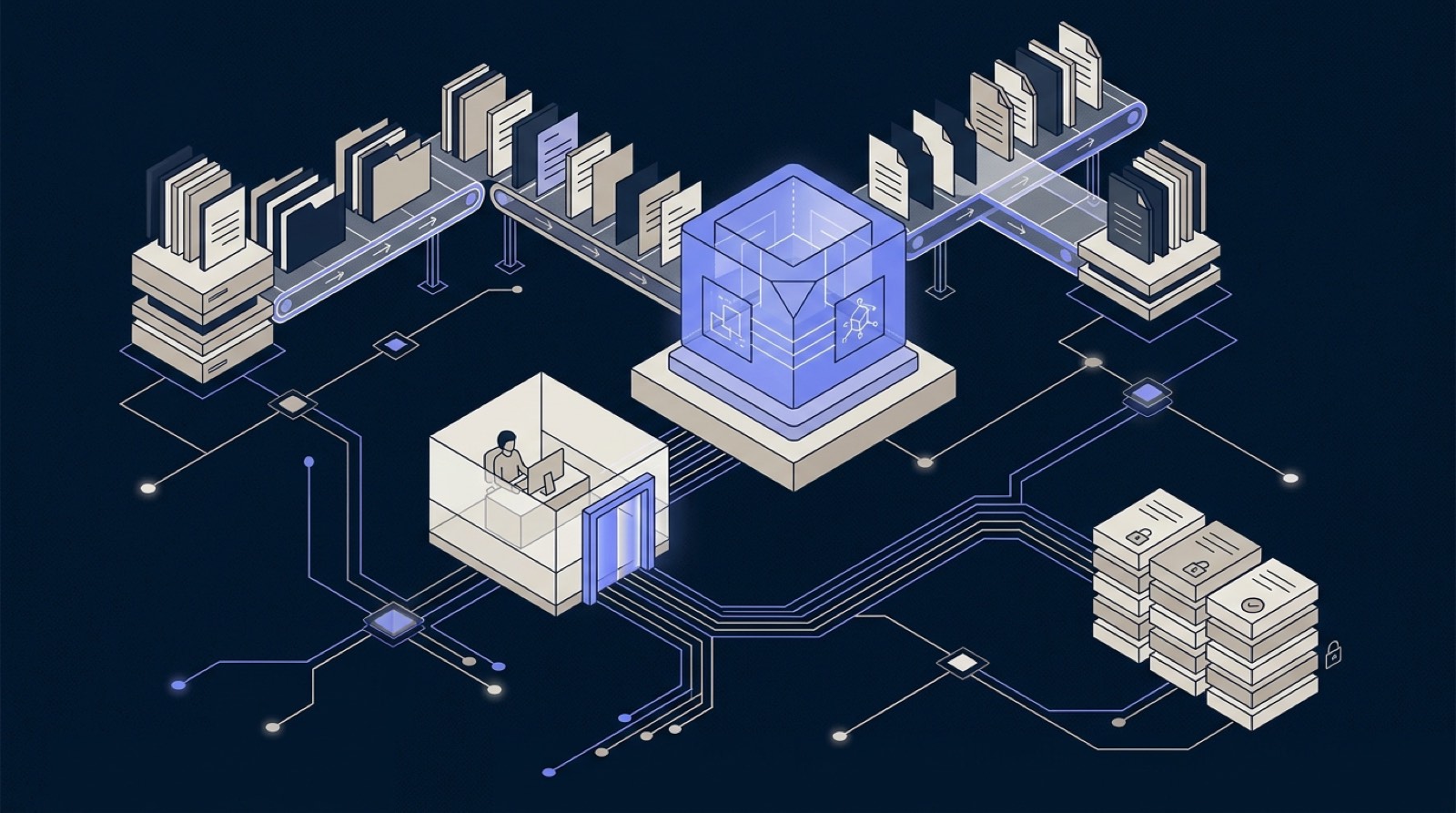
The reading, finding
and reporting.
Document review that eats fee-earner hours
Every matter buries the answer somewhere in a bundle, a case file or a creditor's correspondence. Finding it is slow, and a senior person ends up acting as a human search engine for everyone else.
Case-file retrieval across a sprawling history
The facts of a matter live across emails, attachments, the case-management system and someone's notes. Pulling a coherent picture together is manual, repetitive, and exactly where time leaks.
Reporting assembled by hand, every period
Insolvency reports, creditor updates and the management pack get compiled manually from data that sits in several places. It's a recurring scramble that pulls qualified people off chargeable work.
A confidentiality boundary you cannot cross
Privileged and confidential material can't leak into a public model or leave your environment. That rules out most off-the-shelf AI, and it's exactly the constraint we design around.
Worth a read: AI in legal: from curiosity to operational strategy and why law firms need private AI.
Marshall Peters,
CRM kept intact.
less document-review time
faster reporting
their insolvency case system stayed in place
Private by design,
in the right order.
Inside your
boundary. Full stop.
Every answer cites its source and every action is logged in a full, exportable audit trail. These lines do not move for a deadline, a client, or a confidence threshold.
Nothing leaves your boundary.
Everything runs inside your environment. Nothing trains a public model and nothing privileged or confidential leaves, with role-based access so people only retrieve what they're cleared to see.
We never automate a payment or a change to bank details.
The two highest-risk actions in any operation stay manual, permanently, by design. Not with approval, not with a confidence threshold.
No submission reaches a regulator without explicit human sign-off.
Every regulatory filing sits behind a hard pre-submission gate. The pipeline can assemble it; a named person releases it.
Audit first.
We say no in writing.
A fixed-fee operations review maps your whole operation, scores every workflow on six axes, and hands you a costed, sequenced plan, including the workflows we'd tell you to leave alone. No build is ever priced before we've proven the single hardest thing on your real documents. If the proof fails, there's no build and you don't pay for one.
A fixed-fee operations review
Roughly two to three weeks. A handful of half-day sessions with the people who do the work, plus read access to a representative sample. You own every artefact, whether or not you go on to build.
Will our privileged or confidential material leave our environment?
+
No. We build private AI that runs inside your boundary. Nothing trains a public model and nothing leaves your environment, with role-based access control so people only retrieve what they're cleared to see. Every answer cites the source passage so a claim can always be traced back.
Do we have to replace our case-management system?
+
No. Marshall Peters kept their insolvency CRM (the case and client database they run the firm on). We build around the systems you already use, sitting on top of your case-management platform rather than ripping it out, and remove the manual document review and reporting around it.
What kind of results have you seen for an insolvency firm?
+
For Marshall Peters we cut document-review time by roughly 70% and made reporting around 45% faster, while they kept their existing insolvency CRM. The gain comes from private retrieval over their own documents and compilation engines that assemble reports from live data.
How do you keep this safe and auditable?
+
Every extraction, edit, approval and rejection is logged in a full, exportable audit trail, and output carries field-level confidence scores with low-confidence items flagged for a human. We never automate payments or bank-detail changes, and nothing reaches a regulator without explicit human sign-off.
See where AI pays
back in your firm.
UK STUDIO · REMOTE-FIRST ACROSS THE UK AND EUROPE
[email protected]