
The closed-system last mile.Automated, with a human in the loop.
The model was never the hard part. The value is in the last mile: the MFA-gated portal, the legacy system with no API (no integration point for other software), the login no integration will ever reach.
A supervised AI agent operates those systems the way a trained member of staff would, while a human approves every critical action before it happens. This is the most-stuck, highest-value terrain in a regulated operation, and almost no one else will go near it.
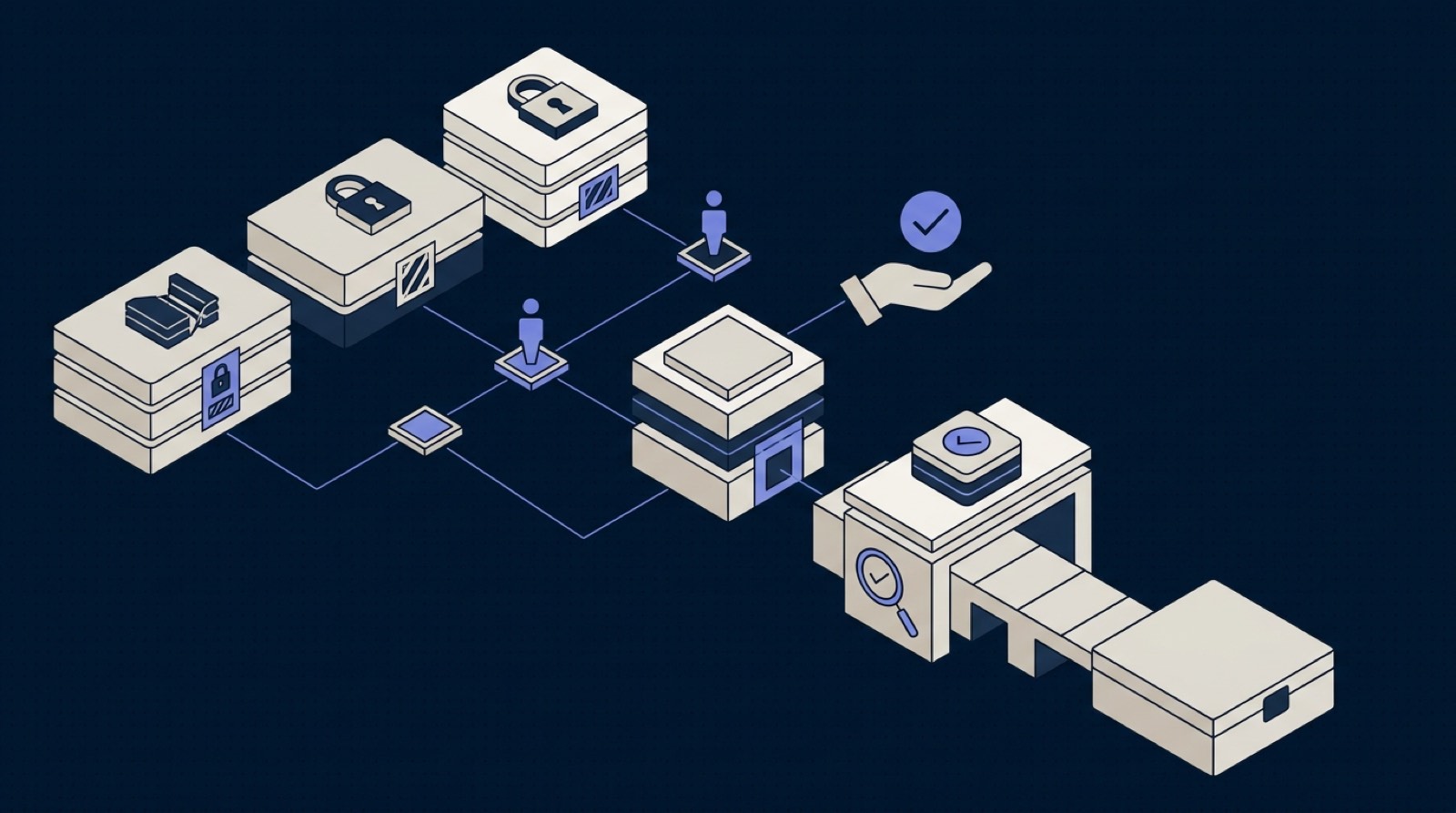
The model was never
the hard part.
In a regulated operation, the painful work doesn't live where an API does. It lives inside systems you'll never get an integration for: the insurer portal, the regulator submission system, the legacy core behind a login. A £50-a-month SaaS can never touch them, because they're closed by design. That's the last mile, and it's where the hours go.
A supervised agent does that work at machine pace, while a human stays accountable for every consequential step.
Like a trained
member of staff.
Logs in and navigates
The agent authenticates and moves through the portal the way a trained member of staff would: through the multi-factor authentication (MFA) gate, into the right screens, to the field that matters.
Reads and enters data
It reads what's on screen and enters data drawn from your reconciled records, so the swivel-chair re-keying between systems disappears.
Pauses for approval
Before any critical action executes, it stops and waits for explicit, per-action human approval. Nothing high-stakes is autonomous.
Escalates and logs everything
Any stuck or unexpected state escalates safely to a human via a failure playbook, and every action is written to a complete, exportable audit trail.
The lines we
will not cross.
Per-action human approval, role-based access control and a complete, exportable audit trail sit behind every agent. These red lines do not move for a deadline, a client, or a confidence threshold.
We never automate a payment.
Not with approval, not with a confidence threshold, not just this once. A human makes payments by hand, every time.
We never automate a change to bank details.
The single highest-fraud-risk action in any operation. It stays manual, permanently, by design.
No submission reaches a regulator without explicit human sign-off.
Every regulatory submission sits behind a hard pre-submission gate. The agent can assemble it; a named person releases it.
The same last mile,
by sector.
Insurance
MFA-gated insurer and managing general agent (MGA) portals where the quote, the bind and the mid-term adjustment all happen by hand.
AI for insurance operationsFinancial services & lending
Lender portals and legacy core systems behind a login, where quoting and reconciliation re-keying eats the day.
AI for financial-services operationsLegal & insolvency
Court and creditor portals, and case systems with no usable API, where filings and updates are entered manually.
AI for legal and insolvency operationsGovernment & public sector
Submission systems and legacy public-sector platforms where accountability and a full audit trail are non-negotiable.
AI for public-sector operationsThe last mile,
measured.
less manual effort, PMD Finance
faster quote turnaround
from start to live
returned to one client (≈£120k/yr)
The top rung
of the Ladder.
Supervised agents are the highest rung of the North Stack Ladder, and we build them last on purpose. You're ready only when the rungs below are proven: clean, reconciled data, a reviewed pipeline that works, and controls a board has signed off. Autonomy only ever rises behind heavier governance, never ahead of it.
Supervised Portal Agents
When you're ready to scope the build, this is the rung-five service that delivers it.
Explore the serviceWhat is a supervised AI agent?
+
A supervised AI agent is software that operates a system through its normal interface, logging in, navigating, reading and entering data the way a trained member of staff would, while a human approves every critical action before it executes. The word that matters is supervised: nothing high-stakes is autonomous.
Can you automate a portal that has no API?
+
Yes. That's precisely the case for a supervised agent. When a system is closed by design (MFA-gated, behind a login, with no usable API) a supervised agent operates it through the same interface a person uses, instead of an integration you can't build. This is the closed-system last mile that off-the-shelf tools can't reach.
How is this different from RPA (robotic process automation)?
+
Traditional RPA replays brittle, hard-coded scripts that break the moment a screen changes, and it has no judgement when something is off. A supervised AI agent reads the screen and adapts, escalates anything unexpected to a human via a failure playbook, and pauses for explicit per-action approval on every critical step, with a complete audit trail behind it.
Is it safe to let an AI agent work inside a regulated system?
+
It's safe because of the supervision, not in spite of it. Every critical action requires explicit, per-action human approval before it executes. There's role-based access control, a complete exportable audit trail of every action, and a failure playbook that escalates any stuck or unexpected state to a human. We never automate payments or bank-detail changes, and nothing reaches a regulator without explicit human sign-off.
What can an agent never do?
+
Two permanent red lines never move: we never automate a payment, and we never automate a change to bank details, not with approval and not with a confidence threshold. And no submission reaches a regulator without explicit human sign-off. The exclusions are the credibility; they're how you know the yes is honest.
When are we ready to deploy a supervised agent?
+
Agents are the top rung of the North Stack Ladder, and we build them last on purpose. You're ready only when the rungs below are proven: clean, reconciled data, a reviewed pipeline that works, and controls a board has signed off. We earn our way up to it; we don't lead with it.
Do you have proof this works in a real operation?
+
Yes. For a UK business finance provider we cut manual effort by roughly 60% and made quote turnaround more than 50% faster, live in around six weeks. Across our work, one client had roughly 900 minutes a day returned (about £120,000 a year) by removing the manual last mile in closed systems.
Automate the last mile
no one else will touch.
UK STUDIO · REMOTE-FIRST ACROSS THE UK AND EUROPE
[email protected]